If you live in the Northern Hemisphere, the winter solstice is the day with the shortest daylight and the longest night of the year. Yet it is not the coldest time — the ancients treated it instead as a lucky day when yang energy first stirs, and celebrated it almost like New Year: dumplings in the north, glutinous rice balls in the south, and the long count of winter's "nines" begins here too. What exactly does the solstice "reach"? Why is it "as grand as the New Year," and why is it the golden window for tonifying? This piece lays out the one day of the year most worth "storing away."
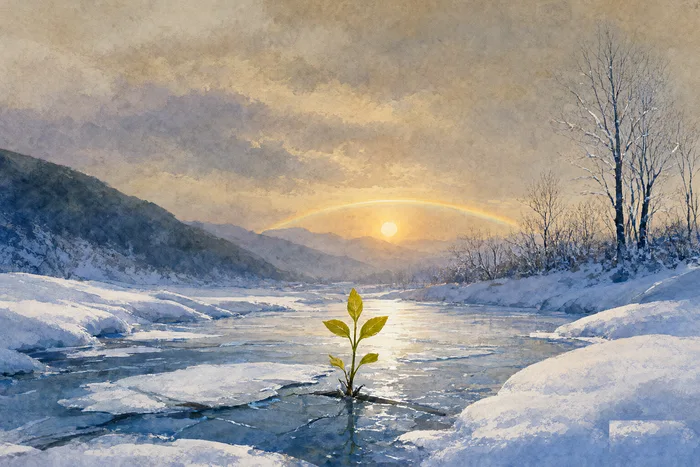
What exactly does the solstice "reach"
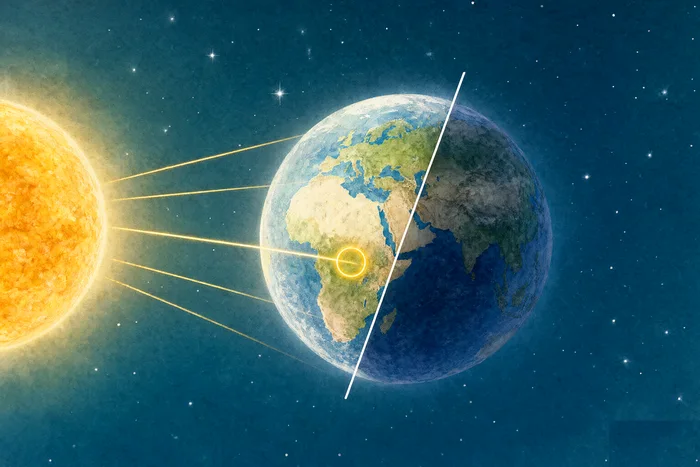
The winter solstice is the 22nd of the 24 solar terms, falling between 21 and 23 December each year. On this day the sun reaches a celestial longitude of 270°, shining almost straight down on the Tropic of Capricorn (23°26′ south); sunlight strikes the Northern Hemisphere at its most slanted, so the north gets its shortest day and longest night, and the farther north you go, the shorter the daylight. After the solstice the point of direct overhead sun "turns around" and heads north, and the days grow longer one by one.
In its oracle-bone form the character 至 (zhì) shows a bird descending from on high to touch the ground: its root sense is "to arrive," which extends to "the utmost, the extreme." The "zhi" of the winter solstice is precisely this "utmost" — the extreme of yin, the extreme of short daylight, the extreme of long shadows. And when things reach the extreme they turn: at the peak of cold, yang begins to stir. That is "at the solstice, one yang is born."
"At the winter solstice yang qi rises; the way of the ruler lengthens — and so there is rejoicing." — Han Shu (Book of Han)
So in the old reading the solstice is a hinge between yin and yang: yin qi waxes to its fullest and begins to wane, while yang first sprouts like a tender shoot. The Yijing (Book of Changes) matches the solstice to the Hexagram Fu (Return), "Earth beneath Thunder," for the meaning of "one yang returning" — this newly born yang is the capital from which next spring's growth will be paid.
The ancients also divided the solstice into three "pentads": first, earthworms still knotted up; second, the elk sheds its horns; third, the springs begin to stir. The coiled earthworm slowly loosens, the elk that senses the yin casts its antlers, and the water hidden beneath the ice starts to move — even in the deepest sealing-away, word of the rising yang gets through.
The heart of the solstice is not "cold" but "turning": the shortest day, cold at its peak, and yang being born at the same moment. The point of winter care is to protect this just-stirred yang — don't drain it, don't crush it.
The solstice is not the coldest day
First, a myth to break: many people reason that since the solstice has the shortest daylight, it must be the coldest day of the year — so they rush to pile on tonics. In truth, around the solstice the ground still holds stored heat; it is losing more than it gains, but has not yet hit bottom. The real bitter cold comes in the "third and fourth nine" after the solstice — as the old saying goes, "cold at the third nine, heat at the third fu."
More important, the solstice marks yang "just born," not yang "at its fullest." This tender yang wants nursing, not brute forcing: if you start straight away with rich meat and heavy tonics, the spleen and stomach cannot transform it, and you get internal heat, bloating, and a jammed qi mechanism instead. Whether you tonify in the right direction matters more than how much you tonify.
As grand as the New Year: an old new year hidden in a solar term
The solstice carries two layers of meaning, natural and human. The ancients saw it as a day of great fortune, because yang returns and a new cycle begins. The Zhou calendar set the month containing the solstice as its first month (the jianzi system), so the solstice was once effectively the "head of the year"; later ages switched to the Xia calendar, but the sayings "the solstice is as grand as the New Year" and "the lesser year" survived — the court sacrificed to Heaven, families honored their ancestors, and friends exchanged New-Winter greetings, every bit as lively as the Lunar New Year.
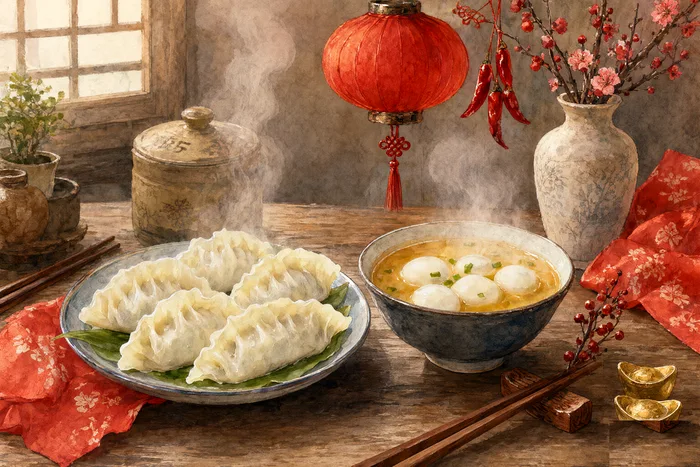
The warmest part of it is the food people eat on this day. A hot seasonal dish both drives off the cold and marks the ritual of coming together and adding a year:
| Region | Solstice dish | The saying and the meaning |
|---|---|---|
| Most of the north | Dumplings (jiaozi) | "Skip the bowl of dumplings at the solstice and no one will mind if your ears freeze off" — said to remember Zhang Zhongjing's "dispel-cold ear-shaped dumpling soup" |
| The Jiangnan south | Tangyuan / solstice rice balls | "Every family pounds rice to make tangyuan" — reunion, and a year added |
| Tengzhou, Shandong | Mutton soup | A bowl of mutton soup at the solstice, to warm and nourish |
| Taiyuan, Shanxi | "Tou nao" (a mutton-and-herb tonic soup) | Tradition credits it to the scholar Fu Shan; drunk on winter mornings to warm the body, with pickled chives and a little flatbread |
| Suzhou, Jiangsu | Winter-brewed wine | A cup of winter wine on solstice night, with braised dishes to see the season in |
Tonifying at the solstice: what you feed is the "newborn yang"
Folk custom holds that "if you tonify at the winter solstice, you'll be strong enough to fight a tiger by spring." The traditional reading is that yang has just been born and the spleen and stomach need warmth, so a measured warming tonic that follows winter's storing tendency helps lay down essence and build a reserve for next year's growth. That is a traditional wellness claim; applied to any one person, the two conditions never change — know your constitution, and make sure your spleen and stomach can actually transform what you take.
- Yang deficiency, cold-averse (cold hands and feet, aversion to cold, low energy): suits gentle warming; mutton, beef, fresh ginger, longan and Chinese chives can be arranged in moderation.
- Yin deficiency with heat (dry mouth, hot palms and soles, flares up easily): tonify by nourishing yin instead — blindly eating mutton and longan pours oil on the fire.
- Heavy Phlegm-Dampness (a heavy body, thick greasy tongue coating): strengthen the spleen and clear dampness before you think about tonifying, or "nothing gets absorbed" — you can check it against Phlegm-Damp Constitution: The Guide to Feeling Heavy, Foggy and Tired.
- Weak spleen and stomach: first settle the digestion with neutral foods like Chinese yam and millet, then build up gradually — don't open with a heavy tonic.
Not sure which one you are? Read The 9 TCM Body Types: Which One Are You? first, or take a constitution test before deciding how to tonify — tonifying in the wrong direction hurts more than not tonifying. Food is not a substitute for medicine.
On this day, how to store the body away well
Brought down to the day itself, winter-solstice care is simply "protect the newborn yang, waste and disturb less." A few things that cost no effort:
- Sleep early, rise late, wait for the daylight. The Huangdi Neijing says of winter to "go to bed early and rise late, always waiting for the sunlight." The solstice night is the longest — sleep early, and get up only once it is properly light; don't force a dawn workout in the darkest, coldest hour.
- Shun cold, seek warmth, guard three spots. The lower back, the ankles and the back of the neck "leak wind" most easily — cover those three first when you go out; before bed soak your feet in warm water (about 40 °C) for 15 minutes, just to the point of warmth, never chasing a scald.
- Warm but not drying, eat a varied plate. Keep the seasonal meal warm; eating a bit of everything beats fixating on one tonic; go easy on iced drinks and large amounts of raw-cold food in winter.
- Quiet the mind, move without heavy sweat. The solstice favors stillness — a walk, Ba Duan Jin, or tai chi to get the qi and blood moving is enough; don't train until you're drenched in sweat with every pore open, letting cold qi walk right in.
Skip warming tonics during a cold with fever, excess heat, or a yin-deficiency flare-up; pregnant people, children, those with chronic conditions, and women during their period should consult a doctor before tonifying. Anyone with cardiovascular disease should be especially careful about winter dawn exercise. Foot-soak water should not be too hot — people with diabetes or lower-limb vascular disease in particular should take care. If fatigue comes with palpitations, breathlessness at rest, obvious weight loss, or persistent unwellness, see a doctor first: wellness care is a daily aid and cannot replace diagnosis and treatment.
FAQ
No. The solstice has the shortest daylight, but the ground still holds stored heat, and the real cold usually comes in the "third and fourth nine" after it. The solstice matters as the turning point where "yang is first born," not as the bottom of the temperature.
Not necessarily. Tonifying should follow your pattern: yang deficiency suits warming, yin deficiency suits nourishing, heavy dampness means clearing the spleen first, and a weak digestion means building it up first. Tonify in the wrong direction and you get heat and bloating instead. If unsure, identify your constitution or ask a TCM practitioner before following the crowd into a heavy tonic.
It depends on the region. The north mostly eats dumplings, the south tangyuan and solstice rice balls; Tengzhou in Shandong has mutton soup, Suzhou drinks winter wine. All are seasonal dishes for warmth and reunion, none better than the others — just eat something hot and varied.
Lidong is the "beginning" of winter; the solstice is its "midpoint" and the yin-yang hinge (shortest day, one yang born). Lidong is about starting to store; the solstice is about protecting the newborn yang, and the count of winter's nines begins here.
A warm foot soak helps drive off cold and relax — about 40 °C, 15 minutes, just warm; take care if you have diabetes or lower-limb vascular disease. Moxibustion is a traditional external therapy that depends on specific technique and pattern differentiation, so do it only under a qualified practitioner's guidance; this article gives no dosage or procedural advice.
A Note from Bong

Have you noticed the winter solstice is a contradiction? The shortest day, the longest night — you'd think the sensible thing is to hush and store, and instead people insist on celebrating it like New Year: wrapping dumplings in the north, rolling tangyuan in the south, honoring the ancestors, exchanging greetings. The old line "the solstice is as grand as the New Year" — the Zhou people really did treat it as the head of the year.
I rather like the contradiction. The bustle is for the people; the storing-away is for the body; the two don't quarrel. On the table, eat a little of everything, keep it warm — that beats fixating on one tonic. In the heart, stop arguing with yourself, and at night put the phone down and lie down earlier. That tender shoot of just-born yang doesn't need you to pile on tonics; it needs you to waste it less.
Today is the solstice. Have you eaten?
AI assistant: a winter-solstice tonic plan made for you
References
- Huangdi Neijing, Suwen, "Treatise on Regulating the Spirit with the Four Qi" — "The three months of winter are called closing and storing... go to bed early and rise late, always waiting for the sunlight," the source of the winter storing-away idea.
- Han Shu (Book of Han) — "At the winter solstice yang qi rises; the way of the ruler lengthens, and so there is rejoicing," an early record of solstice congratulation and the "one yang is born" idea.
- China Meteorological Administration, official notes on the 24 solar terms — the astronomical position of the winter solstice (celestial longitude 270°, direct overhead sun on the Tropic of Capricorn) and its three pentads (earthworms knotted, elk horns shed, springs stirring).
- Wang Qi, Chinese Medicine Body Constitution (TCM constitution studies) — the nine-constitution classification and pattern-based care framework behind "know your constitution before tonifying."
- World Health Organization (WHO), traditional-medicine strategy and related developments: WHO traditional-medicine cooperation.
Check your constitution
Before you tonify, know which constitution you have
18 questions, about 3 minutes, to point your winter-solstice storing and tonifying in the right direction — tonifying correctly matters more than tonifying more.
Take the constitution test