In recent years, the name "ashwagandha" has become a regular sight on the "stress and sleep" shelves of pharmacies in Europe and North America, and has since travelled back into Chinese-language internet wellness culture under the banner of "adaptogens." Its botanical name is Withania somnifera, and it has been used in Ayurveda for roughly three thousand years. Everything below is based on published botanical references and peer-reviewed clinical research, and should not be taken as medical advice.
Two quick facts before you decide whether this is worth your time: ashwagandha belongs to the nightshade family (alongside tomatoes, potatoes, and eggplant), and the part used medicinally is primarily the root. Its most-studied effect is not "vitality" or "brain power" but helping the body cope with chronic stress — specifically, cortisol.
What Is Ashwagandha?
Ashwagandha is the botanical Withania somnifera, a member of the nightshade family. It grows in the dry regions of India, the Middle East, and North Africa as a low gray-green shrub with small yellow-green flowers and red berries. Ayurveda mostly uses the root, dried and ground into a pale brown powder. The species name somnifera comes from the Latin "somnus" (sleep), meaning "sleep-inducing" — likely the reason it first attracted attention.
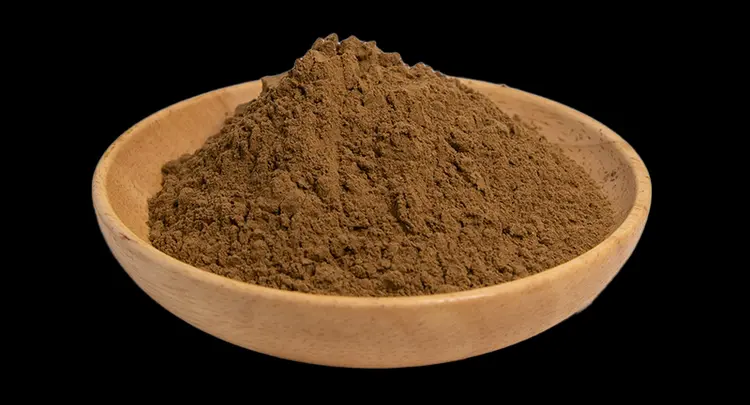
The name itself carries a small piece of folklore: the Chinese rendering "南非醉茄" (literally "South African nightshade") is a mistranslation — it is not native to South Africa and is unrelated to any plant called "醉茄." The more scholarly English nickname is "Indian ginseng," drawn from its reputation as a restorative, though botanically it has no relation to ginseng. Whichever name you see — ashwagandha, Indian ginseng, or winter cherry — it points to the same plant.
Ayurveda and TCM Perspectives
In Ayurveda, ashwagandha is classified as a rasayana — a rejuvenating tonic used to build strength, calm the mind, and slow aging. It is traditionally said to balance vata (wind) and kapha (earth-water) constitutions, and to suit people who are chronically drained, wound tight, and prone to feeling cold — almost a portrait of the modern overworked professional.
Viewed through a TCM lens, it is warm in nature, sweet and pungent in flavor, and leans toward gentle tonification — similar in direction to herbs that "supplement the kidney and settle the spirit," with echoes of ginseng and astragalus, though less stimulating. It should be noted that it is not a traditional Chinese medicine; in China it appears mainly as an imported functional-food ingredient and is not a substitute for proper TCM treatment.
Ashwagandha is neither a sleeping pill nor a stimulant; it is a botanical that helps the body shift back onto a relaxed track. Its researched direction is adapting to stress, not directly suppressing symptoms.
What Modern Research Says
To be direct: the clinical studies on ashwagandha are mostly small, and many are funded by companies that produce the extracts, so conclusions should be read with that in mind. But when the randomized controlled trials are lined up, the direction is consistent — a moderate improvement in stress-related measures.
- A 2012 randomized, double-blind, placebo-controlled trial in India (Chandrasekhar et al.) gave chronically stressed adults 300 mg of standardized root extract daily; after 60 days, perceived stress and cortisol levels dropped clearly while the placebo group barely changed.
- A 2014 systematic review (Pratte et al.) pooled multiple human trials and concluded it offers a statistically meaningful reduction in anxiety symptoms, though the overall evidence is not top-tier.
- A 2019 study in Cureus (Salve et al.) found that 240 mg of standardized extract per day improved stress and sleep quality in healthy adults.
- Another 2019 study (Lopresti et al.) tracked serum cortisol and DHEA-S, again pointing toward stress hormones shifting back toward balance.
Do not get carried away by numbers like "30% lower" or "50% better." The participants were mostly healthy adults who felt stressed, not people diagnosed with an anxiety disorder. Its role is daily support, not treatment.
Cortisol, Stress, and What It Actually Does
When stress hits, the adrenal glands release cortisol to put you into "fight or flight." That is a life-saving mechanism — but when stress is chronic, cortisol stays elevated, and the toll shows up as poor sleep, disrupted appetite, irritability, and a weakened immune system.
Ashwagandha's most researched action is gently pulling elevated cortisol back down. It does not sedate you; it makes the stress switch less likely to trip by accident — so a difficult day no longer sets you off, and your brain is not racing at midnight. This also explains why it gets called both "energizing" and "calming": it regulates balance, not a single direction.
Does It Help with Sleep?
Many people come to it for sleep. Studies show that after 6–8 weeks, time to fall asleep, sleep efficiency, and nighttime awakenings improve to a degree. The striking part is that, unlike sleeping pills, it creates no dependence and no "foggy the next morning" hangover, because it is not forcing the nervous system down — it is lowering stress arousal.
But let us demystify "sleep aid": for long-term, severe insomnia its effect is limited. It nudges mild-to-moderate poor sleep in a better direction. For genuinely severe insomnia, see a doctor — do not reach for a jar of root powder.
How Much to Take
In studies, the most common dose is 300–600 mg per day of standardized root extract (usually standardized to 5%–10% withanolides), split into one or two doses, with food or before bed. If you use raw root powder, the amount is much larger (about 1–2 teaspoons), but absorption and batch consistency are less reliable.
| Form | Reference dose | Notes |
|---|---|---|
| Standardized extract capsules | 300–600 mg/day | Stable, easy to control |
| Raw root powder | 3–6 g/day | Cheaper, but strong taste and batch variation |
| Liquid drops / tea | As labeled | Fast absorption, good if you dislike capsules |
More is not better. High doses can cause stomach upset, drowsiness, or — in rare case reports — liver-enzyme fluctuations. Start low, give your body two weeks to adjust, then decide. Pregnant or breastfeeding women, people with thyroid disease, or active autoimmune conditions should always ask a doctor first.
Capsules, Powder, or Tea
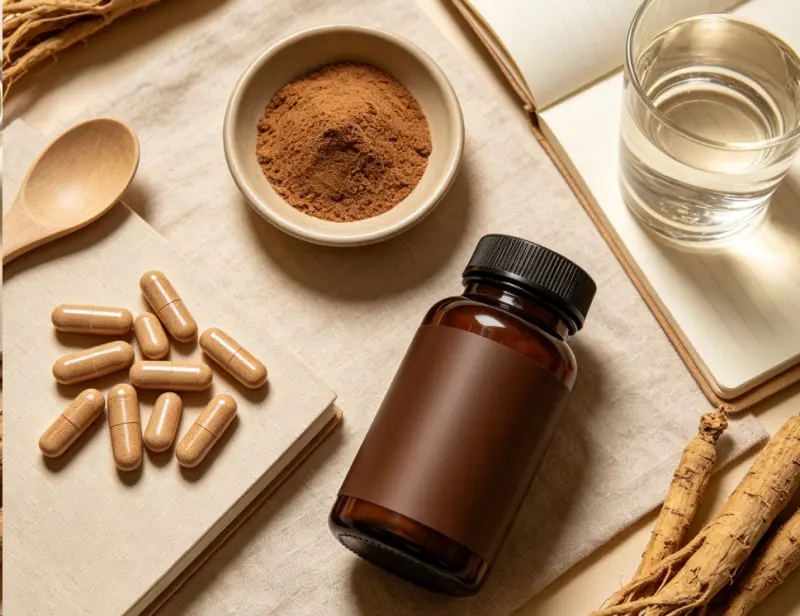
Capsules are the easiest — accurate dose, almost no taste, good for commuters. Root powder has a strong flavor (some describe it as earthy or horsy), but it mixes well into warm milk or oatmeal. Tea is usually a blend with chamomile and other roots — gentler and a good option if you resist capsules.
Golden Milk: A Common Way to Take It
If you have root powder, one common preparation is a pre-bedtime "golden milk" — a pinch of black pepper improves the absorption of withanolides, the same trick used with turmeric:
1 cup warm milk (or plant milk), 1/2 teaspoon ashwagandha root powder, a pinch of black pepper, 1 teaspoon honey or maple syrup.
Heat the milk gently over low heat (do not boil), stirring in the powder and pepper until fully dissolved.
Off the heat, stir in the honey. Sip it slowly 40–60 minutes before bed. Do not over-sweeten — too much sugar works against sleep.
How to Choose a Reliable Product
- Check the standardization: Look for clinically studied extracts like KSM-66 or Sensoril, or a label that states withanolide content (e.g. 5%).
- Check third-party testing: Roots tend to accumulate heavy metals; prefer brands with independent heavy-metal and pesticide testing.
- Check the ingredient list: Avoid vague "proprietary blends" and products loaded with fillers or artificial colors.
- Read the marketing: "Cures anxiety in 7 days" or "instant results" are red flags. Good products do not need to shout.
Who Should Not Take It
The following groups should not self-dose, or should use it only under medical guidance:
- Pregnant or breastfeeding women: traditionally thought to possibly stimulate the uterus; data are insufficient, so avoid to be safe.
- People with thyroid conditions: it may affect thyroid hormone levels.
- Active autoimmune disease: such as rheumatoid arthritis, lupus, or type 1 diabetes; theoretically a risk of immune activation.
- Those on sedatives, anti-anxiety meds, or sleeping pills: possible additive CNS depression.
- Around surgery: may affect anesthesia and sedation; stop about 2 weeks before.
- Allergic to nightshades (history of tomato, potato, or eggplant allergy).
Medication Interactions
Ashwagandha may interact with thyroid medications, sedatives/sleeping pills, antidepressants, diabetes drugs, blood-pressure drugs, and immunosuppressants. If you take prescription medication — especially for thyroid, blood sugar, or blood pressure — have a doctor or pharmacist look at it before you start, rather than ordering it online yourself.
FAQ
Most studies observe 4–8 weeks. It adjusts your stress baseline rather than acting instantly, so do not expect a transformation after two days.
High-quality safety data beyond a few months are lacking. A common approach is to cycle: 8–12 weeks on, then 2–4 weeks off.
Not for most people, but if you are sensitive, take the main dose in the evening or before bed.
Yes. But if you rely on coffee to power through stress, dealing with that dependency matters more than any supplement.
That happens and is normal — individual responses vary and product quality varies widely. First confirm it is a standardized extract, at 300 mg or more, for at least 4 weeks before concluding it does nothing.
A Note from Bong

Ashwagandha has grown so popular that even our small, slow-content site has finally had to write a proper article about it. When a plant takes off on pharmacy shelves in the West and in Chinese wellness feeds at the same time, it is rarely pure smoke — at the very least, the pharmacy is not keeping a whole shelf of it out of charity.
Before writing this, I deliberately avoided reading marketing copy first. What I looked at were published clinical trials and the record of ashwagandha in Indian and Western pharmacopoeias. The conclusion is unglamorous: it has evidence in a narrow band — helping people under chronic pressure bring their stress response down a notch. As for "vitality," "brain power," or "longevity," the literature I found does not support those claims, so I will not repeat them on its behalf.
It is neither a miracle herb nor a scam. It is more like a decent tool: with the right person, the right dose, and the right expectations, it can do a little good. Expect it to carry all your late nights and anxieties on its own, and you are asking too much. Whether to try it is between you and your doctor.
May you sleep well tonight.
References
- Chandrasekhar K, et al. A prospective, randomized double-blind, placebo-controlled study of safety and efficacy of a high-concentration full-spectrum extract of ashwagandha root in reducing stress and anxiety. Indian Journal of Psychological Medicine, 2012. View on PubMed
- Pratte MA, et al. An alternative treatment for anxiety: A systematic review of human trial results reported for the Ayurvedic herb ashwagandha (Withania somnifera). Journal of Alternative and Complementary Medicine, 2014. View on PubMed
- Salve J, et al. Adaptogenic and anxiolytic effects of ashwagandha root extract in healthy adults: A double-blind, randomized, placebo-controlled clinical study. Cureus, 2019. View on PubMed
- Lopresti AL, et al. An investigation into the stress-relieving and pharmacological actions of an ashwagandha (Withania somnifera) extract. Medicine, 2019. View on PubMed
Not Sure Where Your Stress Comes From?
Spend 3 minutes understanding your stress, sleep, and energy patterns before deciding whether you need supplements or a lifestyle change.
Start the Quiz