Picture a Monday in December, in some city in the Northern Hemisphere. When the alarm first goes off you are actually already awake — just awake in a strange state: your body feels as if it has been filled with cement from the outside, your eyelids are too heavy to lift, and the fog in your head will not clear no matter how hard you blow. You hit snooze and promise yourself just two more minutes. When you open your eyes again, forty minutes have gone by, and you are more tired than before.
The strangest part is that you did sleep. You went to bed at ten last night and were dragged up by the alarm at six this morning — a full eight hours, perfectly respectable on paper. Yet the day still defeats you: coffee to survive the morning, eyelids fighting at the three o'clock meeting, then oddly alert at nine in the evening, so tomorrow you repeat ten-to-bed, six-to-rise, and still cannot get up.
This article wants to do four things for you. First, split "cannot get up" into three different problems — not enough sleep, not deep enough sleep, and a clock set to the wrong hour — because their solutions are completely different, and lumping them together only leaves you blaming your own laziness. Second, explain why winter makes it so much worse: the modern-medical answer may be the opposite of what you think. Winter does not steal your sleep duration; it shifts the hour on the clock inside you. Third, look at how Chinese medicine understands "not waking in the daytime," including one line most people read backwards. Fourth, give you a "go get checked" list and a seven-day plan you can try without buying anything.
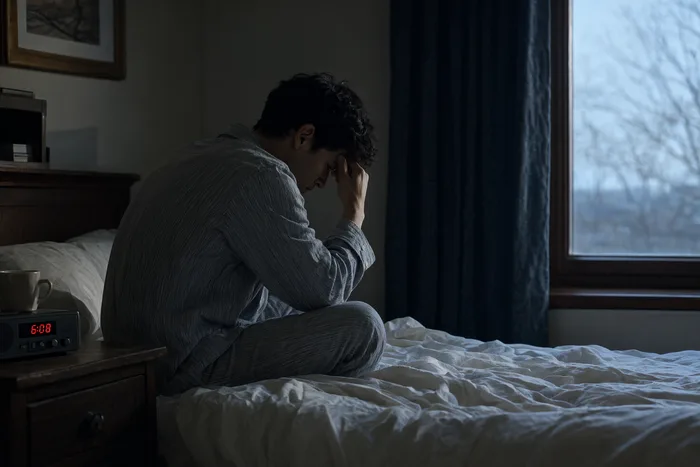
First tell three things apart: not enough sleep, not deep sleep, a clock set wrong
"Cannot get up" is not one illness. It is the shared expression of three completely different problems. Without telling the types apart, every effort is like typing blind.
| Type | Typical signs | Key clue | Direction |
|---|---|---|---|
| Not enough sleep (sleep debt) | Can sleep ten hours on weekends; dozes off sitting down; needs coffee by mid-morning | Gap between workday and rest-day sleep length is over an hour and a half | Restore the total first, then talk about anything else |
| Not deep sleep (fragmentation) | Eight hours in bed still unrefreshed; wakes many times at night; partner says you snore | Dry mouth or headache on waking; repeated night waking; weight quietly creeping up | Check sleep breathing and current medications — see section six |
| Clock set wrong (circadian misalignment) | Falls asleep late (only after 1 a.m.), forced awake in the morning, worst in the morning | On unforced weekends you naturally sleep and rise two or three hours later; jet lag on trips actually resolves faster | Light and a wake-time anchor — see section seven |
The third is most often mistaken for a mix of the first two, and most often brushed off with "you are just lazy." Its signature: sleep length and quality are both passable, but your body clock and your social schedule are in different time zones. There is a very easy test — look at when you wake naturally on a rest day. If nobody wakes you and you sleep until ten or eleven and rise feeling clear-headed, you are probably not short on sleep; you are misaligned.
As for why the third type gets markedly worse once winter sets in, we first need to settle something more basic: that morning struggle is not all a problem in itself.
Those two hours after waking have a normal allowance
Sleep medicine calls the grogginess right after waking sleep inertia: a transitional state with low alertness, where short-term memory and judgment are both discounted. Its typical length is 15 to 30 minutes; but when someone is yanked out of deep sleep, or is already sleep-deprived, it can stretch to around two hours. This magnitude has been measured repeatedly in the lab. A 2023 Delphi-method consensus on sleep hygiene for shift workers is more specific: keep naps to 15–20 minutes — beyond 20 minutes you are more likely to amplify that post-waking grogginess — and avoid high-risk tasks in the period right after waking.
So "my brain feels like it is behind frosted glass for the first hour" is not itself abnormal. What is worth chasing are two other things: whether it exceeds two hours every day, and why it gets worse specifically once winter arrives.
The criterion is not "can I get up?" but "how long until I reach a state where I can work normally." The former you can bluff through with willpower; the latter cannot be faked.
The answer starts with light. Not the buy-a-lamp kind of light, but how much brightness you are actually exposed to each day.
What winter really moves is the hour, not the clock face
The most widespread claim is this: winter days are short, the body secretes melatonin for longer, so you are sleepier. This holds for most mammals — they judge what month it is by the duration of nighttime melatonin, and use it to molt, store fat, and prepare for breeding. But humans are a little different.
A group of researchers in Prague measured healthy city-dwellers twice, summer and winter (one day in early July, one in mid-January), with interesting results: the duration of the nighttime melatonin rise showed no significant difference between summer and winter; the difference was in timing — the winter melatonin rhythm shifted about 1.5 hours later. In other words, winter did not lengthen your night; it pushed the whole night toward morning. So when the alarm rings, the melatonin inside you has not left the stage yet — you are not sleeping too much, you are being woken too early.
A hormone secreted by the pineal gland at night, whose job is to send the body the "it is dark" signal, helping you fall asleep and maintaining the night's sleep tendency. It is often treated as the hand of the body's clock: the onset time measured under dim light (DLMO) is the most widely used phase marker in research. Its secretion is suppressed by light, especially short-wavelength blue-green light — so evening lamps and screens delay it, and morning natural light advances it.
You are not sleeping too much. You are being woken too early.
So why is it the hour that moves? Because this human system sets its watch mainly by light, not by the clock. And winter does three things to light, each pushing in the same direction.
First, no light in the morning. In most cities it is still dark during the commute; you wake two or three hours before sunrise, which means being forced to boot up every day before your body clock has received the dawn signal. Second, a daytime light cliff. Third, more light at night: it gets dark early, people stay indoors under lamps and in front of screens, pushing back the time melatonin should start rising.
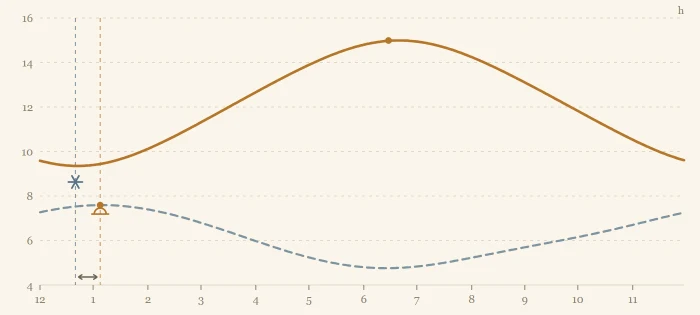
The point of this chart is not the exact numbers but the orders of magnitude: the indoors you think is bright is often only a few dozen to a few hundred times dimmer than outdoor natural light. Ten minutes walking outside on an overcast day delivers more light signal than a whole day sitting in a bright office. This is also why "do not sunbathe through glass in the morning" is not mysticism — glass blocks a substantial share of light, and the magnitude you receive sitting by a window is in a completely different league from stepping outside.
Following this logic leads to another conclusion: since the problem is the hour being pushed back, the solution is not "sleep a bit more" but setting the clock back. The most effective lever for advancing the human body clock is, precisely, morning light. This was tested at a polar research station: people overwintering at Antarctica's Halley station received one hour of bright white light from 08:30 to 09:30 each day during midwinter; two weeks later their sleep and circadian phase had advanced about 0.9 hours overall, wake time moved earlier too, and daytime performance improved in step (the duration of nighttime melatonin never differed between summer and winter — what moved was the phase).
But however precisely you tune the light, there is one situation it cannot fix: your schedule itself manufactures a small jet lag every week.
How Chinese medicine sees excessive sleeping: a question asked two thousand years ago
"Always wanting to sleep in the daytime" — Chinese medicine not only has a name for it, but specifically discussed its mechanism. The name is duō mèi (excessive sleeping); older texts more often write it as "sleeping much" or "fond of lying down."
The question is posed as "When a person sleeps excessively, what qi brings this about?" — someone always short of sleep, unable to rise in the daytime: what qi causes it? The original answer runs: "This person's intestines and stomach are large and the skin is damp, so the flesh is not smooth. With large intestines and stomach the defensive qi lingers long; with damp skin the flesh is not smooth and its movement is slow. Now the defensive qi by day travels in the yang and by night in the yin; so when the yang qi is exhausted one lies down, and when the yin qi is exhausted one wakes." Three layers: first, the person's gut is large, so defensive qi stays inside longer; second, between skin and muscle it is not smooth, so defensive qi moves slowly on the outside; third, the defensive qi's rule is to travel in yang by day and yin by night — linger too long in the yin, fail to clear, and the person always wants to close their eyes. The same chapter adds: "When pathogenic qi lingers in the upper burner and the upper burner is closed and blocked, then after eating and drinking hot soup the defensive qi lingers long in the yin and does not move, so one suddenly sleeps a great deal" — why a big hot meal makes you too sleepy to lift your head: the two-thousand-year-old explanation matches you after lunch today exactly.
In Chinese medicine, the part of qi that runs along the body surface and between the muscles, described as fierce and swift — it moves fast, travels the surface, spreads through the yang by day so the person is alert and awake, and enters the yin at night so the person falls asleep. "Defensive qi not moving" is used in the classics to explain both excessive sleepiness and insomnia — opposite directions, same mechanism: where it should be, and when it should arrive.
Translating this old text into a picture readers recognize is easy — you surely know someone like this: not exactly fat but with a soft belly, politely spoken, half a beat slow at everything, impossible to wake in the morning, head heavy and muzzy as if wrapped in a wet cloth by day, stools that never flush clean, a thick white tongue coating. Chinese medicine's name for this state is dampness encumbrance (shī kùn; textbooks call it dampness excess trapping the spleen), with key descriptors: head muzzy as if wrapped, heavy limbs, fullness in the chest and epigastrium, poor appetite with nausea, a greasy coating and a soggy pulse.
Current Chinese internal-medicine textbooks divide excessive sleeping into four common patterns, located in the heart and spleen and closely related to the kidney, root-deficient and branch-excess by nature:
| Pattern | Core signs | Treatment direction |
|---|---|---|
| Dampness excess trapping the spleen | Head heavy as if wrapped, drowsy and sleepy, heavy limbs, chest tightness and poor appetite, loose sticky stools, white greasy coating | Dry dampness and strengthen the spleen; awaken the spirit and open the orifices |
| Spleen qi deficiency | Mental fatigue, especially sleepy after meals, poor appetite, sallow complexion, weak limbs, weak pulse | Boost qi and raise the clear |
| Yang qi decline | Sleepy all day, reluctant to speak, aversion to cold and cold limbs, pale tongue, deep thin pulse | Boost qi and warm yang |
| Blood stasis obstruction | Often a history of head injury or chronic illness, sleepiness with forgetfulness, fixed-location headache, dark tongue | Invigorate blood and resolve stasis |
Two others are often mentioned alongside. Zhang Zhongjing's Shanghan Lun (Treatise on Cold Damage), on shaoyin disease, gives a six-character outline: "the pulse is faint and thin, and one only wishes to sleep" — the whole person wilted, wanting only to lie down and sleep; this is the classic description of the yang-deficiency type. The Jin-Yuan lineage of Li Dongyuan is more direct: such people are commonly seen with weak spleen and stomach; spleen deficiency breeds dampness internally, and once dampness encumbers, the clear yang cannot rise. Zhu Danxi, discussing dampness, also left phrases like "heavy and powerless, sluggish and fond of lying down."
Interestingly, this explanation does not conflict with modern medicine's division of labor — it complements it. Modern medicine is good at answering "which named disease is it" — thyroid, iron deficiency, sleep apnea. Chinese medicine is good at handling the stretch where every marker is normal but the person just is not alert. And that stretch is precisely where most people who cannot get up in winter actually are.
Speaking of "cannot get up in winter," you cannot avoid the most-quoted and most-misread line in the Huangdi Neijing (Yellow Emperor's Inner Classic).
Bed early, rise late, wait for the sunlight — the second half gets dropped
The Suwen's "Treatise on Regulating the Spirit with the Four Qi" says of winter: "The three months of winter are called closing and storing; water freezes and the earth cracks; do not disturb the yang; go to bed early and rise late, always waiting for the sunlight." These eight characters are the opening line of nearly every winter wellness article, and are often read as the ancestors' endorsement of staying in bed.
But read the two clauses together and the meaning is exactly the opposite. "Always waiting for the sunlight" is a condition, not a free pass. It says: rising late is fine, but wait until it is light — once up, you should see light; do not keep lying in the dark. And the preceding "do not disturb the yang" does not mean "do not exercise"; it means do not forcibly stir the yang in the bitter-cold early morning: do not go out for vigorous exercise before dawn, do not stand in the wind after sweating heavily.
Following this reading, the two worst winter arrangements are both named: one is dragging yourself up before dawn and gritting through it (disturbing the yang, with no light signal); the other is sleeping until noon, then getting up and staying in a dim room with the curtains drawn (sleeping away the "wait for sunlight" itself). The former is brute force; the latter is pushing yourself later with your own hands every day.
A counterintuitive corollary
If you rise at six in the dark on workdays and sleep until noon on weekends, the signal your body receives is: this week you took a round-trip flight. The earlier you rise on workdays and the harder you compensate on weekends, the more Monday feels like jet lag. Catching up on sleep is not itself wrong; turning catch-up sleep into "delaying the light" is.
With the direction clear, next comes the one thing you must do first: before labeling yourself "heavy dampness" or "just how winter is," rule out several named, testable, treatable conditions.
Rule out these named conditions first
Fatigue and daytime sleepiness are among the most common complaints in primary care. A review in the German medical journal Deutsches Ärzteblatt International puts it plainly: most chronic fatigue has an explanation — either an identifiable disease or a changeable lifestyle. But only if someone actually investigates and asks, rather than filing it under "that is just modern life."
If these three appear, stop treating it as "just winter"
① So sleepy by day that you nod off driving, fall asleep in meetings, or lose the thread mid-sentence. Especially if you snore loudly at night, family say you stop breathing in your sleep, and you wake with a dry mouth and headache — you need a formal evaluation for sleep apnea. These people often think they sleep plenty, and are exactly the group most easily missed.
② Sudden, unexplained, overwhelming sleepiness. Especially with headache, fever, limb weakness, confusion, or personality change — go to the emergency room, do not wait, and do not come looking for a food remedy first.
③ Low mood, no longer wanting to do things you used to enjoy. Depression often shows up in the body first as "cannot get up, cannot move, cannot sleep enough," not as sadness. If this state arrives punctually every autumn and lifts on its own in spring, it deserves to be evaluated as a real condition — the previous article on seasonal low mood, Autumn Blues: Why Your Mood Drops in Fall, and What Helps, goes into more detail.
Beyond these, there is a group that one blood draw basically covers. The table below lists the items often pointed to — only what to test and which marker to watch; the interpretation is for your doctor:
| Direction | Common markers | Why it ties to "cannot get up" |
|---|---|---|
| Thyroid function | TSH (add FT4 if needed) | Hypothyroidism's classic signs are fatigue, cold intolerance, sleepiness, constipation, weight gain |
| Iron status | Complete blood count + ferritin | Low ferritin can cause fatigue before anemia appears; more common in women with heavy periods and long-term vegetarians |
| Vitamin B12, folate | Serum B12, folate | Vegetarians, the elderly, and long-term stomach-medication users are high-risk for low levels |
| Blood sugar and liver | Fasting glucose, HbA1c, liver function | Blood-sugar swings and metabolic problems often first signal as daytime drowsiness |
| Current medications | Bring your full medication list to the doctor | Antihistamines, some blood-pressure drugs, painkillers, antidepressants and sleep aids all cause daytime sleepiness |
One here deserves special mention because it is most often missed: iron deficiency is not the same as anemia. While hemoglobin is still in the normal range, ferritin may already be very low, and fatigue may already be present. A systematic review of randomized controlled trials found that in non-anemic iron-deficient adults, iron supplementation improved fatigue but not physical capacity — that is, the subjective "no energy" precedes the anemia on the lab report. In another double-blind trial of 144 women who were tired for no findable reason but not anemic, the group on four weeks of oral iron had fatigue scores drop about 29%, versus about 13% for placebo; and post-hoc grouping showed the benefit concentrated in those whose ferritin was already low (≤50 µg/l).
But this is precisely the one you should least take into your own hands: iron is not a "take it and feel alert" thing. Long-term supplementation without clear deficiency brings gastrointestinal reactions, and more trouble still, it can mask the real cause of bleeding — heavy periods or gastrointestinal blood loss can both show up as low iron. Whether to supplement, for how long, and when to recheck after a few weeks must be decided by a doctor.
Once these are ruled out, the remainder is where lifestyle comes in. The seven-day plan below requires you to buy nothing.
A seven-day plan you can finish without buying anything
The core of this is one sentence: treat wake time as the anchor and morning light as the switch. Everything else is supporting.
- Fix your wake time, weekends included, within 30 minutes. This matters more than going to bed early. To sleep more, move bedtime earlier, not wake time later — pushing wake time later sends your body clock the signal "dawn came late today."
- Get outside for 10–20 minutes within an hour of waking. Overcast counts; not through glass. If you cannot go out, move breakfast, replies, and reading to the brightest spot by a window.
- Keep your morning coffee, but set the last cup for early afternoon. Caffeine is metabolized by the hour in healthy adults; the commonly used half-life estimate is 4–6 hours. At that rate, the three o'clock cup still leaves roughly 30–40% in your blood at ten at night. It may not keep you awake, but it can make sleep shallower and the next morning harder.
- Swap the bedtime drink for zero. A 2025 systematic review and meta-analysis clarified the dose relationship: about two standard drinks are enough to delay the onset of REM sleep and compress its duration, more so the more you drink; while "falling asleep faster" was only observed at high doses around five standard drinks. As for total sleep time, sleep efficiency, and night wakings, the evidence is still uncertain — but the pattern "knocks you out first, then collects the bill in the second half of the night" is clear enough.
- If you nap by day, set the alarm under 20 minutes and place it in the early afternoon. Oversleeping makes it likelier you are yanked from deep sleep and wake groggier than before — the most typical sleep-inertia scenario.
- Move exercise to daytime. It need not be vigorous; twenty minutes of brisk walking is enough. Save vigorous for before evening — too late delays sleep onset.
- Make the bedroom a little cooler and darker. A common winter mistake is heating on full and curtains sealed: overheating at night plus total darkness in the morning amplifies sleep inertia.
How to judge whether it worked after seven days? Watch two things: first, how long after waking until you reach a normal state (not whether you can get up); second, whether you still want to catch up on sleep on the weekend. If on day seven your weekend wake time is nearly the same as workdays, the direction is right. If the day still defeats you, or any red flag above appears, it is not a schedule problem — go get checked.
Schedule is the skeleton; food is the flesh. But on "what to eat," the common winter mistake is not eating the wrong tonic — it is getting the direction backwards.
Direction in the kitchen: dampness first transforms, yang deficiency then warms
The previous article on the first two days of a wind-cold cold gave a saying about direction: the same bowl of ginger-and-jujube soup acts in exactly opposite ways at two stages. On winter sleepiness the direction problem is even more common, because many people hear "winter calls for warming tonics" and drink ginger, red dates, and lamb all the way down.
The problem is that Chinese medicine's two most typical explanations for "not alert by day" point in different directions.
The dampness-encumbrance type is marked by a heavy body, muzzy head, thick white greasy tongue coating, stools that stick to the bowl, and special sleepiness after meals. This person's problem is not insufficient fire — it is that the pipes are gummed up with damp turbidity, so the clear yang cannot rise. Pouring in warming, rich things like ginger-jujube tea or lamb soup now is like adding heating to a damp room — the person gets heavier. The direction is to transform first: everyday foods like millet, Chinese yam, white hyacinth bean, coix seed, winter melon, and aged tangerine peel — light and spleen-strengthening — while first cutting rich, sweet, alcohol, and raw-cold. Aromatic transformation of dampness is the keyword for this type, which is why clean-scented things like aged tangerine peel and agastache belong on this path.
The yang-deficiency type is marked by cold intolerance, cold limbs, mental exhaustion, a pale tongue, and a deep thin pulse; by day it is not sleepy but wilted. This is the type that gets warming: a morning cup of ginger-jujube tea (3 slices of fresh ginger, 3 red dates, simmered 15 minutes, not too much sugar), moderate longan and lamb in winter, and a hot foot soak at night. You need not decide between the two types yourself — a Chinese-medicine constitution self-test lays out the scores for all nine tendencies.
As for the part that applies to everyone, it is actually plain: do not white-knuckle the morning on an empty stomach, and do not make dinner the biggest meal of the day. Big blood-sugar swings translate directly into morning drowsiness; and the Lingshu's "On Great Confusion" line — "after eating and drinking hot soup, the defensive qi lingers long in the yin and does not move" — describes exactly why a full meal makes you sleepy. This has not changed in two thousand years; there is just a new version now: a high-carb lunch buys you the three o'clock collapse. If you also have the "no matter how I tonic, I am never alert" trouble, another article on common causes of fatigue, Why Am I Always Tired? 10 Overlooked Causes and TCM-Style Fixes, pairs well.
FAQ
Eight hours is an average, not a quota. The American Academy of Sleep Medicine and the Sleep Research Society recommend 7 hours or more for adults, and individual variation is real. A more practical criterion is daytime function: can you get through the morning without coffee, do you lose control in the afternoon, do you revenge-sleep on weekends? Answer yes to all three and you are chronically in debt.
Probably not, and it may make things worse. Melatonin is not a sleeping pill; it is more like the "it is dark" signal to the body, a phase cue, usually used to move bedtime earlier (taken some hours before the intended sleep). What someone who cannot get up really needs is to advance the body clock, and morning light does that better than a pill at bedtime. Wrong timing or large doses can scramble the rhythm further and mask the cause you should be investigating. Whether and how to use it — ask a doctor or pharmacist.
Insufficient yang qi is one pattern of excessive sleeping, but the more common one is actually dampness encumbrance — both show as not wanting to move and not waking refreshed, yet the directions are opposite: one needs warming, the other needs dampness transformed and diet lightened first. Judging looks at the tongue coating, degree of cold intolerance, stools, and post-meal sleepiness as a set of clues; a constitution self-test or an in-person consult beats guessing. As for tonics: any tonic only makes sense if the direction is right; wrong direction just adds burden. With underlying conditions, on medication, pregnant or nursing, all the more do not treat food therapy as treatment.
A Note from Bong

For a stretch I was working late into the night, and in daytime meetings I could not be bothered to finish a sentence even when it was on the tip of my tongue. My verdict on myself then was "this person has turned lazy." Only later did I understand: it was not laziness — my qi was low in that period, and saying one sentence meant first saving up a breath.
I once summed up three phrases for people who sleep badly: put down the phone, get near plants, let go of the obsession. The first is easiest, the second I can just about manage, the third I still have not managed to this day. It probably should not be written in a wellness article, yet it is the most effective of the three.
As for winter, I now make just one promise to myself: once awake, pull the curtains open; if I can go out, walk ten minutes. No negotiating, and no expecting instant results. Daybreak does not need your permission anyway.
References
- Lingshu (Spiritual Pivot), "On Great Confusion" (Da Huo Lun) — the question "When a person sleeps excessively, what qi brings this about?": "With large intestines and stomach the defensive qi lingers long... it lingers long in the yin, its qi is not clear, so one wishes to close the eyes, hence excessive sleeping"; also in the same chapter, "When pathogenic qi lingers in the upper burner and the upper burner is closed and blocked, after eating and drinking hot soup the defensive qi lingers long in the yin and does not move, so one suddenly sleeps a great deal." Quotations follow the common edition (other editions read "rough skin" and "its qi is not refined").
- Lingshu, "Oral Questions" (Kou Wen) — "When the yang qi is exhausted and the yin qi flourishes, the eyes close"; Suwen, "Treatise on Regulating the Spirit with the Four Qi" — "The three months of winter are called closing and storing; water freezes and the earth cracks; do not disturb the yang; go to bed early and rise late, always waiting for the sunlight... this is the response to winter qi, the way of nourishing storage."
- Han dynasty, Zhang Zhongjing, Shanghan Lun (Treatise on Cold Damage), "Shaoyin Disease Pulse Patterns and Treatment" — the shaoyin outline "the pulse is faint and thin, and one only wishes to sleep"; Jin-Yuan, Zhu Danxi, Danxi Xinfa (Danxi's Methods), "On Dampness," on "heavy and powerless, sluggish and fond of lying down," and the Li Dongyuan lineage's approach from the spleen and stomach.
- The common Chinese Internal Medicine textbook, heart-system chapter on excessive sleeping (duo mei) — located in heart and spleen, related to kidney, root-deficient branch-excess; common patterns: dampness excess trapping the spleen, spleen qi deficiency, yang qi decline, blood stasis obstruction; pattern descriptors such as "head muzzy as if wrapped, heavy limbs, chest tightness and poor appetite, white greasy coating, soggy pulse."
- Hilditch CJ, McHill AW. Sleep inertia: current insights. Nature and Science of Sleep 2019;11:155-165 — definition, typical duration, and influencing factors of sleep inertia (sleep stage at awakening, sleep deprivation, circadian phase).
- Tassi P, Muzet A. Sleep inertia. Sleep Medicine Reviews 2000;4(4):341-353 — the time course of cognitive recovery after awakening; some measures take about two hours to stabilize.
- Shriane AE, Rigney G, Ferguson SA, Bin YS, Vincent GE. Healthy sleep practices for shift workers: consensus sleep hygiene guidelines using a Delphi methodology. Sleep 2023;46(12):zsad182 — shift-worker sleep hygiene consensus: naps recommended at 15–20 minutes, longer more likely to produce sleep inertia, avoid high-risk tasks in the period right after waking.
- Watson NF, Badr MS, Belenky G, et al. Recommended Amount of Sleep for a Healthy Adult: A Joint Consensus Statement of the American Academy of Sleep Medicine and Sleep Research Society. Journal of Clinical Sleep Medicine 2015;11(6):591-592 — adults should obtain 7 hours or more of sleep.
- Illnerová H, Zvolsky P, Vaněček J. The circadian rhythm in plasma melatonin concentration of the urbanized man: the effect of summer and winter time. Brain Research 1985;328(1):186-189 — summer-vs-winter comparison of plasma melatonin rhythm in urban populations (early July, mid-January): no significant difference in the duration of the nighttime melatonin rise; winter phase about 1.5 hours later than summer.
- Corbett RW, Middleton B, Arendt J. An hour of bright white light in the early morning improves performance and advances sleep and circadian phase during the Antarctic winter. Neuroscience Letters 2012;525(2):146-151 — at Antarctica's Halley station (75°S) in midwinter, one hour of bright white light daily from 08:30 to 09:30; after two weeks, circadian phase and wake time advanced about 0.9 hours, cognitive performance improved.
- Wittmann M, Dinich J, Merrow M, Roenneberg T. Social jetlag: misalignment of biological and social time. Chronobiology International 2006;23(1-2):497-509 — definition of social jetlag (difference between workday and rest-day sleep midpoint) and its association with health markers.
- Maisel P, Baum E, Donner-Banzhoff N. Fatigue as the chief complaint: epidemiology, causes, diagnosis, and treatment. Deutsches Ärzteblatt International 2021;118(33-34) — epidemiology, cause composition, and diagnostic pathway of fatigue as a presenting complaint.
- Houston BL, Hurrie D, Graham J, et al. Efficacy of iron supplementation on fatigue and physical capacity in non-anaemic iron-deficient adults: a systematic review of randomised controlled trials. BMJ Open 2018;8(4):e019240 — iron supplementation improves fatigue but not physical capacity in non-anemic iron-deficient adults.
- Verdon F, Burnand B, Stubi C-LF, et al. Iron supplementation for unexplained fatigue in non-anaemic women: double blind randomised placebo controlled trial. BMJ 2003;326(7399):1124 — comparison of fatigue-score reduction between iron and placebo groups in non-anemic women with low ferritin.
- Gardiner C, Weakley J, Burke LM, et al. The effect of alcohol on subsequent sleep in healthy adults: a systematic review and meta-analysis. Sleep Medicine Reviews 2025;80:102030 — about two standard drinks (≤0.50 g·kg⁻¹) suffice to delay REM sleep onset and shorten its duration, more so at higher doses; shortened sleep-onset and deep-sleep latency observed only at high doses (≥0.85 g·kg⁻¹); evidence on total sleep time, sleep efficiency, and night wakings is highly uncertain.
- European Food Safety Authority (EFSA). Scientific Opinion on the safety of caffeine. EFSA Journal 2015;13(5):4102 — safety assessment of caffeine at various doses in healthy adults, also noting marked individual variation in caffeine metabolism.
- On the orders of magnitude of light (clear-sky noon ~100,000 lux, overcast outdoors ~10,000 lux, indoor lighting a few hundred lux) and the astronomical facts of day length and latest-sunrise timing varying with latitude: order-of-magnitude statements common in lighting-engineering and light-therapy literature, plus public astronomical almanacs; used here only to illustrate relative gaps, not as precise measurements.
Measure your sleep first, then decide which line to change
Is your problem "not enough sleep" or "a clock set wrong"?
The sleep-quality quiz gives a comparable score across three directions — falling asleep, night waking, and daytime state — in about 5 minutes. It cannot detect your thyroid and gives no diagnosis; its job is to turn "how have I been sleeping lately" from a feeling into a number, so you can articulate it when adjusting your schedule or seeing a doctor. As for whether you are the dampness-encumbrance or yang-deficiency sort, the TCM constitution self-test lays out the scores for all nine tendencies. Relax — both are free.
Take the sleep-quality quiz